Healthier LifeStyles

The ReStart Initiative's Vision:
We use commerce and compassion to help men, women, and children to live healthy enriched lives.
The ReStart Initiative's Mission:
To utilize the Gross Domestic Product to support social solutions
Your Information is Protected When You Sign Up
Why We Collaborate:
Because the needs of communities are increasing and everyone should help. ReStart is committed to households elevation from being In-Crisis, At-Risk, Safe, Stable, to Thriving; producing Community Wealth.
Your Information is Protected When You Sign Up




Trauma

Your Information is Protected When You Sign Up
Self-Actualization Begins
With Affordable Housing
Consistent Employment
Establish Financial Confidence
Literacy Drives
Adult Employment Success
Effectiveness in Ensuring
Safe Childcare
Child Literacy Changes Lives
Economic Prosperity
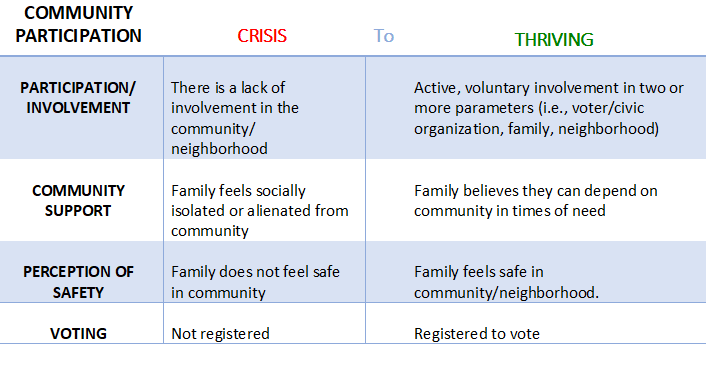
Community Participation
Empowers Households
Family Safety is Important
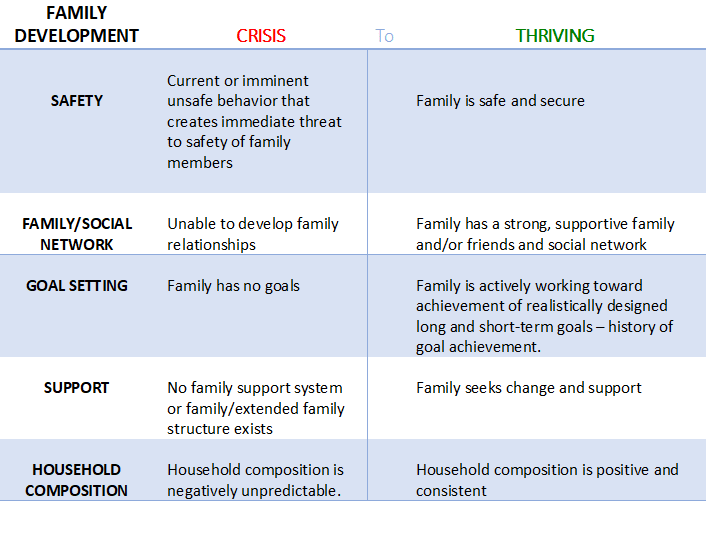
Bringing Community Together
Healthy Lifestyles - Crisis to Thriving
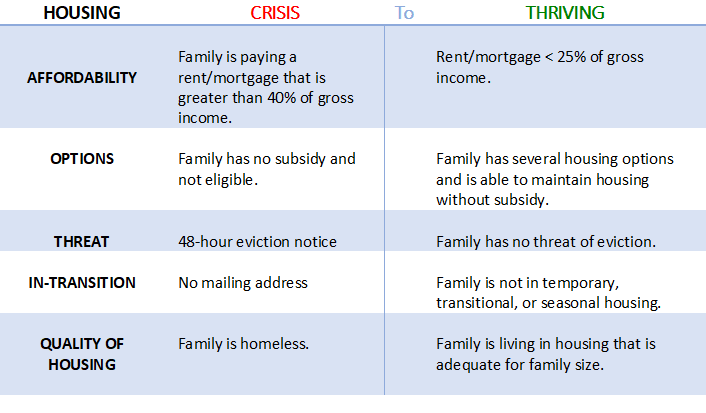
EMPLOYMENT SCALE AND INDICATORS
| Employment Type | Wages | Benefits | Skills/Work History | Number of Boxes Checked |
|---|---|---|---|---|
|
THRIVING Permanent stable employment of choice. |
Wages exceed expenses (food, clothing & shelter). |
Has full benefits (health, dental, vision). |
Has marketable skills. Job mobility available. |
4 3 2 1 0 |
|
STABLE Permanent & stable job. |
Wages adequate for (food, clothing, & shelter) expenses. |
Has full benefits (health, dental, vision). |
Job advancement available. |
4 3 2 1 0 |
|
SAFE Job temporary or seasonal (including contract position). |
Wages adequate for (food, clothing, & shelter) expenses. |
Needs assistance to supplement benefits (public assistance, free care, etc.). |
Has marketable skills. |
4 3 2 1 0 |
|
AT-RISK Job temporary or seasonal (including contract position) or unemployed seeking job. |
Wages inadequate for (food, clothing, & shelter) expenses. |
Needs public assistance. |
Has limited skills. |
4 3 2 1 0 |
|
IN-CRISIS Unemployed; not seeking job. |
Wages inadequate for (food, clothing, & shelter) expenses. |
Needs public assistance. |
No skills or no/bad work history. |
4 3 2 1 0 |
EDUCATION & LITERACY (CHILD EDUCATION) SCALE AND INDICATORS
| Attendance | Parents’ Involvement | Academic Performance | Development | Number of Boxes Checked |
|---|---|---|---|---|
|
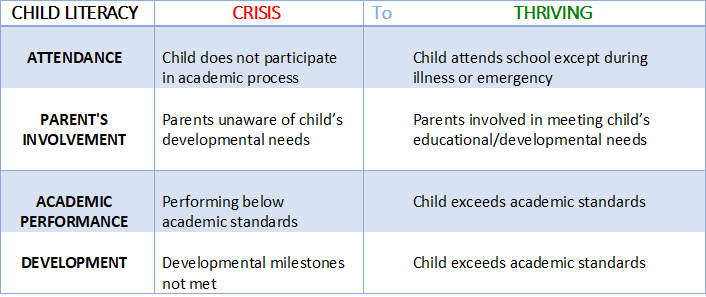
THRIVING Child attends school except during illness or emergency. |
Parents involved in meeting child’s educational/developmental needs. |
Child exceeds academic standards. |
Meets developmental standards. |
40 30 20 10 |
|
STABLE Child attends school except during illness or emergency. |
Parents involved in meeting child’s educational/developmental needs. |
Child meets academic standards. |
Meets developmental standards. |
40 30 20 10 |
|
SAFE Child attends school except during illness or emergency. |
Parents involved in child’s educational/developmental needs and performance. |
Child meets academic standards. |
Some developmental milestones met. |
40 30 20 10 |
|
AT-RISK Insufficient school attendance. |
Parents aware but unresponsive to child’s developmental needs. |
Performing below academic standards. |
Few developmental milestones achieved. |
40 30 20 10 |
|
IN CRISIS Child does not participate in academic process. |
Parents unaware of child’s developmental needs. |
Performing below academic standards. |
Developmental milestones not met. |
40 30 20 10 |
EDUCATION AND LITERACY (ADULT EDUCATION) SCALE AND INDICATORS
| Learning/ Credential | Planning | Literacy | Skills | Values | Number of Boxes Checked |
|---|---|---|---|---|---|
|
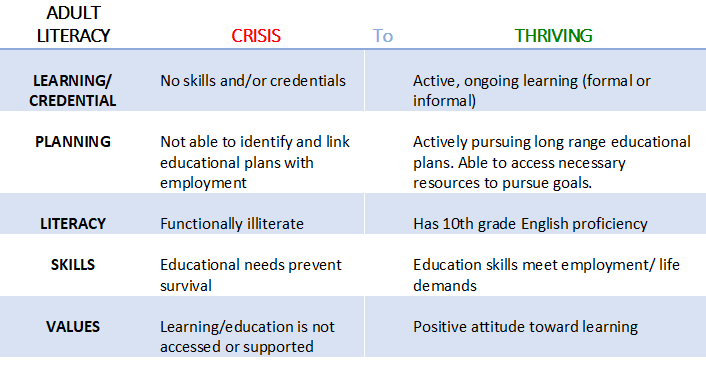
THRIVING Active, ongoing learning (formal or informal). |
Actively pursuing long range educational plans. Able to access necessary resources to pursue goals. |
Has 10th grade English proficiency. |
Education skills meet employment/ life demands. |
Positive attitude toward learning. |
50 40 30 20 10 |
|
STABLE Active, ongoing learning. |
Able to construct educational plans. |
Has 10th grade English proficiency. |
Education skills meet employment/ life demands. |
Positive attitude toward learning. |
50 40 30 20 10 |
|
SAFE Has high school diploma, GED or vocational training. |
Ability to identify and link educational plans with employment. |
Has 8th - 10th grade English proficiency. |
No language barrier to day-to-day functioning. |
Positive attitude toward learning. |
50 40 30 20 10 |
|
AT-RISK Seeking GED or vocational training. |
Not able to identify and link educational plans with employment. |
Has less than 6th grade English proficiency. |
Lack of language skills is a barrier to day-to-day functioning. |
Learning/ education is not accessed or supported. |
50 40 30 20 10 |
|
IN CRISIS No skills and/or credentials. |
Not able to identify and link educational plans with employment. |
Functionally illiterate. |
Educational needs prevent survival. |
Learning/ education is not accessed or supported. |
50 40 30 20 10 |
HEALTH SCALE AND INDICATORS
| Health Coverage | Affordability | Family Health | Substance/ Alcohol Abuse | Mental/ Behavioral Health | Number of Boxes Checked |
|---|---|---|---|---|---|
|
THRIVING Family has full coverage, which includes primary, preventative, mental, dental, vision, and prescription. |
Co-payments are affordable. Family has capacity to access health services. |
Family members are in good health and/or accessing health services. |
Absence of substance/alcohol abuse or long-term (at-least one year) sobriety. |
Ability to meet and identify one’s mental health and behavioral needs. |
50 40 30 20 10 |
|
STABLE Family has full health coverage, which includes primary care & prevention but, 1 or more not covered: mental, dental, vision, and prescription. |
Co-payments are affordable. |
Family members are in good health and/or accessing health services. |
Continuance of sobriety. |
Working to meet mental health and behavior needs. |
50 40 30 20 10 |
|
SAFE Health care available with a subsidy. |
Inconsistent use of health care system. |
Preventative care. |
Completed treatment. |
Ability to cope with unmet mental health and behavior needs. |
50 40 30 20 10 |
|
AT-RISK Limited access to medical care with no primary care provider. |
Inappropriate use of the health care system. |
Unsound basic health/ hygiene. |
Current treatment for substance or alcohol abuse. |
Unmet mental health and behavior needs. |
50 40 30 20 10 |
|
IN CRISIS No health coverage. |
No/very limited access to free care. |
Family member(s) have critical untreated health problems; and/or medical disability. Poor basic health/hygiene. |
Active substance abuse/ addiction. |
Unable to get treatment for unmet mental health and behavior problems. |
50 40 30 20 10 |
YOUTH AND FAMILY DEVELOPMENT (CHILDCARE) SCALE AND INDICATORS
| Choice | Availability | Overall Quality | Number of Boxes Checked |
|---|---|---|---|
|
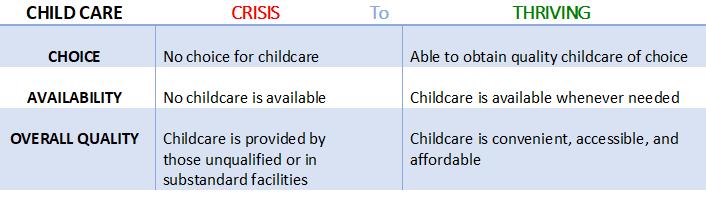
THRIVING Able to obtain quality childcare of choice. |
Childcare is available whenever needed. |
Childcare is convenient, accessible, and affordable. |
30 20 10 |
|
STABLE Some choice for childcare is available. |
Childcare is available during most needed hours. |
Childcare is reliable, affordable, and accessible. |
30 20 10 |
|
SAFE Childcare is available with subsidy. |
Childcare is available during the most needed hours. |
Cost of childcare impacts family finances. |
30 20 10 |
|
AT-RISK Childcare is partially available and/or difficult to access. |
Hours of childcare are limited. |
Childcare is inconsistent, unreliable, and/or unaffordable. |
30 20 10 |
|
IN-CRISIS No choice for childcare. |
No childcare is available. |
Childcare is provided by those unqualified or in substandard facilities. |
30 20 10 |
RESIDENT PARTICIPATION SCALE AND INDICATORS
| Participation / Involvement | Community Support | Perception of Safety | Voting | Number of Boxes Checked |
|---|---|---|---|---|
|
THRIVING Active, voluntary involvement in two or more parameters (e.g., voter/civic organization, family, neighborhood). |
Family believes they can depend on community in times of need. |
Family feels safe in community/neighborhood. |
Votes regularly. |
40 30 20 10 |
|
STABLE Ongoing participation in one of the following: voter/civic participation, family, neighborhoods and/or community involvement. |
There is a feeling of a sense of belonging and investment in the community/neighborhood. |
Family feels safe in community/neighborhood. |
Votes regularly. |
40 30 20 10 |
|
SAFE There is an awareness of community issues and a history of sporadic involvement. |
There is a feeling of a sense of belonging and investment in the community/neighborhood. |
Family feels safe in community/neighborhood. |
Registered to vote. |
40 30 20 10 |
|
AT-RISK There is a lack of involvement in the community/neighborhood. |
Family perceives a lack of support from the community/neighborhoods. |
Family does not feel safe in community. |
Not registered to vote. |
40 30 20 10 |
|
IN CRISIS There is a lack of involvement in the community/neighborhood. |
Family feels socially isolated or alienated from community. |
Family does not feel safe in community. |
Not registered to vote. |
40 30 20 10 |
NUTRITION SCALE AND INDICATORS
| Emergency/ Supplemental Food | Access | Nutritional Practice | Number of Boxes Checked |
|---|---|---|---|
|
THRIVING No reliance on emergency or supplemental food resources. |
Family has access to or ability to select high quality food and preparation. |
Family has consistent, good nutritional practice. |
30 20 10 |
|
STABLE No reliance on emergency or supplemental food resources. |
Family has access to/ability to select high quality food and preparation. |
Family has consistent access to well-balanced meals that meet all minimum dietary requirements. |
30 20 10 |
|
SAFE No reliance on emergency food but may access supplemental food resources (e.g., WIC, food stamps, etc). |
Family has consistent access to well-balanced meals. |
Meet all minimum (and special) dietary requirements (not RDA). |
30 20 10 |
|
AT-RISK Dependence on emergency food resources. |
Limited ability to acquire, prepare nutritious, safe food. |
Minimum dietary requirements for special conditions not met. |
30 20 10 |
|
IN CRISIS No access to emergency food. |
No means to acquire, prepare, or store food. |
Minimum dietary requirement not met. |
30 20 10 |

341-314-7179
© Copyright 2022. The ReStart Initiative, L3C
All rights reserved.
We’re on a mission to build a better future for everyone.